Dream Journal KDP Interior: A Technical and Creative Guide for Publishers
The low-content publishing landscape has evolved significantly from simple lined notebooks to specialized, niche-specific tools. Among these, the Dream Journal KDP Interior stands out as a unique asset for creators looking to serve the mindfulness, psychology, and spiritual wellness communities. Unlike generic journals, a dream diary requires specific structural elements to be truly useful to the end consumer. For publishers utilizing Amazon’s print-on-demand services, understanding the technical specifications and user experience design of these interiors is paramount to creating a product that sells and satisfies.
This guide explores the practical application, technical requirements, and strategic value of using a pre-formatted Dream Journal KDP Interior for your publishing business. Whether you are a seasoned KDP veteran or a new entrant testing the waters of no-content books, understanding the nuances of this specific interior type can streamline your workflow and enhance your catalog's quality.
The Functional Anatomy of a Dream Journal Interior
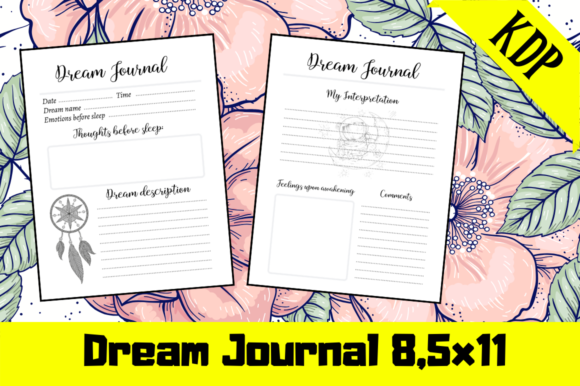
To appreciate the value of a professionally designed interior, one must first understand what distinguishes a dream journal from a standard diary. When evaluating or utilizing a Dream Journal KDP Interior, the layout must facilitate the immediate capture of subconscious imagery upon waking. The cognitive state between sleep and wakefulness is fleeting; therefore, the interior design must reduce friction.
A high-quality interior typically includes several distinct sections beyond simple writing space:
- Date and Sleep Metrics: Dedicated fields for bedtime, wake time, and sleep quality ratings help users correlate dream patterns with physical rest.
- Narrative Space: Ample room for free-writing the dream sequence without restrictive lines that might stifle creative recall.
- Emotion and Symbol Tracking: Checkboxes or tag clouds allowing users to quickly identify recurring themes, emotions, or archetypes.
- Lucidity Indicators: Specific prompts for those practicing lucid dreaming techniques, such as reality checks or intention setting.
- Interpretation Notes: A separate section for reflection, distinguishing the raw dream data from the conscious analysis.
When you acquire a ready-to-print file, ensure it contains these functional variants. A superior Dream Journal KDP Interior often provides multiple layout options within the same file package, allowing publishers to create a series or offer customers variety without redesigning from scratch.
Technical Specifications: Ensuring KDP Compliance
The most common point of failure for low-content publishers is formatting errors during the upload process. Using a tested, pre-formatted interior mitigates this risk. For this specific asset, adherence to precise technical standards is non-negotiable.
Trim Size and Bleed Settings
The standard trim size for this interior is 8.5 x 11 inches. This dimension offers sufficient surface area for detailed dream mapping and writing while remaining cost-effective regarding page count and shipping weight. Crucially, this interior is designed with no bleed.
In KDP terminology, "no bleed" means all content, including text, graphics, and borders, must remain within the safe zone, typically 0.375 inches from the edge on all sides. Because dream journals often utilize decorative frames or corner elements, a no-bleed PDF ensures that none of these artistic touches are trimmed off during manufacturing. When uploading to KDP, you must explicitly select "No Bleed" in the printing options to match the PDF metadata. Selecting "Bleed" for a no-bleed file will result in scaling issues or rejection.
Page Count and File Variants
This specific interior package features 121 pages. This number is strategically chosen for several reasons:
- Durability: Books under 100 pages can sometimes feel insubstantial or have binding limitations. 121 pages provides a spine width adequate for legible title text.
- Usability: It allows for approximately three to four months of daily logging, which is an ideal duration for habit formation without being overwhelming.
- Royalty Optimization: The page count balances printing costs against potential royalty margins at standard price points.
Furthermore, the inclusion of 5 different variants of PDF files is a significant operational advantage. Rather than publishing a single book, a publisher can utilize these variants to test market preferences. One variant might feature minimalist line art, another might focus on prompt-heavy layouts, and a third could emphasize visual sketching space. All five should be rigorously tested for KDP compliance, ensuring margins, gutter safety, and resolution meet Amazon’s evolving standards.
Target Audience and Market Application
Understanding who buys a Dream Journal KDP Interior product informs how you position the final book. The audience for dream journals is diverse, spanning clinical, spiritual, and creative demographics.
Therapeutic and Psychological Users
Mental health professionals often recommend dream journaling as part of Cognitive Behavioral Therapy for Insomnia (CBT-I) or trauma processing. These users require structured interiors that encourage objective recording rather than mystical interpretation. Interiors with clean, clinical layouts and emotion-tracking metrics appeal strongly to this segment.
Spiritual and Esoteric Practitioners
Conversely, users interested in astrology, tarot, or spiritual growth seek interiors that accommodate symbolic interpretation. They benefit from layouts that include moon phase tracking, zodiac references, or open spaces for drawing symbols. Utilizing the different PDF variants allows you to target both the clinical and spiritual niches simultaneously without alienating either group.
Creatives and Problem Solvers
Artists, writers, and entrepreneurs often use dream journals to access subconscious creativity. For this demographic, the Dream Journal KDP Interior serves as an idea incubator. Layouts that mix unlined space with dotted grids or mind-mapping templates are particularly valuable here.
Evaluating Quality Before Publishing
While pre-made interiors save time, due diligence is necessary to ensure long-term success. Before uploading any Dream Journal KDP Interior, perform the following quality checks:
- Gutter Margin Verification: Open the PDF and measure the inner margin. For a 121-page book at 8.5x11, the gutter should be at least 0.375 to 0.5 inches to prevent text from disappearing into the binding. Dream journals are often used in bed or while holding the book with one hand; a tight gutter ruins usability.
- Paper Opacity Considerations: KDP standard paper is 55# (90 GSM). If the interior uses heavy black ink or large solid areas, show-through may occur. High-quality interiors account for this by keeping reverse-side content light or offsetting graphics so they do not align perfectly back-to-back.
- Prompt Originality: Ensure any included prompts or quotes are in the public domain or original. Copyright infringement in interiors can lead to account termination.
- Visual Consistency: Review all 5 variants to ensure they maintain a cohesive brand aesthetic if you plan to sell them as a collection.
Strategic Advantages for Low-Content Businesses
Integrating a specialized Dream Journal KDP Interior into your business model offers distinct advantages over generic notebook creation. The primary benefit is perceived value. Customers recognize that a purpose-built tool solves their problem better than a blank slate. This perception supports higher price points and improves conversion rates.
Additionally, the "ready for printing" nature of these files accelerates time-to-market. In the competitive KDP ecosystem, speed matters. Having 100 formatted and tested assets means you can pivot quickly to trending topics within the dream and wellness niche without spending weeks on design and proofing. The 5-variant structure also facilitates A/B testing of covers and keywords. You might find that a "Lucid Dreaming Guide" cover converts better with Variant C, while a "Sleep Therapy Log" cover performs best with Variant A.
Practical Expectations and Limitations
While a pre-formatted interior is a powerful asset, it is not a magic solution. Publishers should manage expectations regarding customization. Since these are finished PDFs, you cannot easily move elements or change fonts without source files. This limitation reinforces the importance of selecting an interior that aligns perfectly with your vision before purchase.
Furthermore, the no-bleed constraint requires careful cover design. Your cover must account for the specific spine width calculated for 121 pages on white paper. Using a cover template generator with incorrect page counts or paper type settings will result in misalignment. Always generate a fresh cover template based on the exact specifications of the interior file.
Finally, remember that the interior is only half the product. Success in the dream journal niche depends heavily on keyword research, compelling cover design, and accurate categorization. The Dream Journal KDP Interior provides the foundation, but your marketing strategy builds the house.
Conclusion
The Dream Journal KDP Interior represents a convergence of technical precision and user-centered design. By offering 121 pages of no-bleed, 8.5x11 formatted content across five distinct variants, it addresses the practical needs of both the publisher and the end-user. For professionals and creators in the low-content space, leveraging such specialized assets transforms a hobbyist approach into a scalable, quality-focused business. Success lies not just in uploading a file, but in understanding the human need behind the product and delivering a seamless, compliant, and valuable reading experience.