Evaluating Task Priority KDP Interior: Format, Size, and Practical Application
Selecting the correct interior template is often the most critical technical decision for low-content and medium-content publishers on Amazon. While cover design attracts the initial click, the interior determines customer satisfaction, review ratings, and long-term sales velocity. The Task Priority KDP Interior represents a specific category of functional planning tools designed to help users organize responsibilities based on urgency and importance rather than simple chronological listing. When evaluating this resource, publishers must consider not just the conceptual layout but the technical specifications that dictate market fit. Specifically, understanding the implications of the available 6x9 inch and 8.5x11 inch sizes, as well as the distinction between PDF and JPG source files, is essential for making an informed publishing decision.
Defining the Task Priority Framework in Print
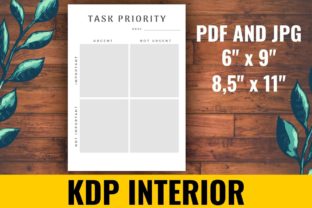
A Task Priority KDP Interior differs fundamentally from standard daily planners or generic to-do lists. Standard notebooks typically offer lined space or undifferentiated checkboxes, placing the cognitive load of prioritization entirely on the user. In contrast, a task priority interior integrates a methodology directly into the page structure. These templates often utilize quadrant systems, ranking scales, or categorical segmentation to force the user to distinguish between high-impact activities and busy work before writing begins.
This distinction matters significantly for market positioning. When researching alternatives, you will encounter many "productivity journals" that are essentially repurposed notebooks. A true Task Priority KDP Interior provides scaffolding for executive function. For adults aged 20 to 50 managing careers, households, or side businesses, this structural support is the primary value proposition. The interior does not merely record tasks; it facilitates a decision-making process. When comparing options, verify that the layout actually enforces prioritization logic rather than simply providing headers labeled "Priority" without supporting visual hierarchy or categorization fields.
Comparing Size Options: 6x9 vs. 8.5x11 Inch
The availability of both 6x9 inch and 8.5x11 inch versions addresses two distinct user behaviors and use cases. Choosing between them requires analyzing where and how the end-user intends to interact with the book. There is no universally superior size; there is only the size that best fits the specific niche you are targeting.
The Portability Factor of 6x9
The 6x9 inch format is the industry standard for trade paperbacks and personal journals. Its primary advantage is portability. This size fits easily into backpacks, purses, and glove compartments, making it ideal for users who need to capture and prioritize tasks while in transit. For a Task Priority KDP Interior, the 6x9 size suggests a personal, daily companion. It works best for individual contributors, students, or professionals whose workflow is mobile.
However, the tradeoff is writing space. Prioritization frameworks require room for categorization, notes, and task migration. On a 6x9 page, margins and binding gutters consume valuable real estate. If the interior design is too dense, users may find the prioritization sections cramped, leading to frustration. When evaluating a 6x9 Task Priority KDP Interior, ensure the layout has been specifically optimized for smaller dimensions rather than simply scaled down from a larger format. Text legibility and writable space must remain uncompromised.
The Functional Utility of 8.5x11
The 8.5x11 inch format serves a different master: desktop utility. This size offers nearly double the writable area of the 6x9 version, allowing for more complex prioritization matrices, extensive note-taking sections, and larger typography. This format is frequently preferred by project managers, educators, and individuals using the planner as a stationary desk reference rather than a carry-along journal.
From a production standpoint, the 8.5x11 Task Priority KDP Interior allows for greater design flexibility. Complex frameworks like Eisenhower Matrices or detailed weekly reviews breathe better on this canvas. The tradeoff is lack of portability and higher printing costs. Users purchasing this size expect a comprehensive workstation tool. If your target audience values depth of organization over mobility, the 8.5x11 variant is likely the stronger choice. Comparatively, this size also competes more directly with traditional office stationery and spiral-bound planners, so the perceived quality of the interior layout must be professional and uncluttered.
Technical File Formats: PDF vs. JPG Considerations
The availability of Task Priority KDP Interior files in both PDF and JPG formats presents a technical decision point that affects both production workflow and final print quality. Understanding the strengths and limitations of each format prevents costly publishing errors.
PDF: The Industry Standard for Interiors
For KDP interiors, PDF is generally the preferred and recommended format. PDFs preserve vector data, ensuring that lines, text, and geometric shapes remain crisp at any zoom level or print resolution. When uploading a Task Priority KDP Interior, a properly configured PDF embeds fonts and locks dimensions, preventing the shifting or reflowing that can ruin a structured planner layout.
Furthermore, PDFs allow for precise control over bleed and trim settings. Since prioritization planners often feature elements extending to the page edge, accurate bleed configuration is non-negotiable. Most professional design software exports print-ready PDFs with these parameters intact. If you are choosing between formats for final publication, PDF should be the default selection for its reliability and typographic fidelity.
JPG: Flexibility and Limitations
JPG files serve a different purpose in the ecosystem. They are raster-based images, meaning they consist of pixels rather than vectors. While having a Task Priority KDP Interior available in JPG format offers flexibility for preview generation, marketing mockups, or digital-only distribution, it carries risks for print production. If the resolution is insufficient (below 300 DPI), lines may appear pixelated or blurry in the physical book.
However, JPGs can be useful during the evaluation phase. They allow potential buyers or researchers to quickly view the layout without needing specialized PDF readers. Some creators also use JPGs to assemble custom interiors if they lack vector editing software. If you choose to publish using JPGs, rigorous quality checking is mandatory. Compare the file size and dimensions carefully against KDP’s specifications. In almost all direct comparisons for print quality, PDF outperforms JPG for structured interiors, but JPG remains a valuable supplementary format for versatility.
Evaluating Content Depth and Page Count
The specification of 100 pages for a Task Priority KDP Interior places it in a strategic middle ground within the low-content market. This page count influences both the user experience and the economic viability of the product.
One hundred pages typically translates to approximately three months of daily use or six months of bi-daily/weekly tracking, depending on the layout density. This duration aligns well with quarterly goal-setting cycles, a popular timeframe for adults focusing on professional development or habit formation. Compared to thinner 60-page notebooks, which can feel insubstantial, or massive 200-page volumes, which can feel daunting and increase printing costs significantly, the 100-page format offers a balanced entry point.
When researching alternatives, pay attention to how those 100 pages are utilized. Some interiors pad page counts with excessive introductory content, quotes, or blank filler pages to reach minimum spine width requirements. A high-quality Task Priority KDP Interior maximizes functional space. Evaluate whether the page count reflects genuine utility or artificial inflation. For users comparing resources, a leaner, fully functional 100-page book often provides better value per dollar than a thicker book with lower information density.
Decision Factors: When This Interior Fits Your Needs
Determining whether a Task Priority KDP Interior is the right choice involves honest assessment of your publishing goals or personal organizational needs. This format excels in specific scenarios but may fall short in others.
Choose this interior type when:
- Your target audience struggles with overwhelm and needs external structure to sort urgent versus important tasks.
- You want to differentiate from saturated generic notebook markets by offering functional utility.
- You require a versatile asset available in multiple sizes to test different niche segments simultaneously.
- You need print-ready files that minimize formatting troubleshooting during the upload process.
Consider alternative options when:
- The intended use is purely creative journaling, free-writing, or sketching, where structure inhibits expression.
- You require specialized tracking features (e.g., financial ledgers, medical logs, academic grading) that general task prioritization cannot accommodate.
- Your audience prefers digital-only solutions and has explicitly rejected paper-based planning tools.
- You need extensive customization capabilities beyond what pre-formatted PDF/JPG files allow.
Making an Informed Selection
The landscape of KDP interiors is crowded, but quality and specificity remain reliable differentiators. A Task Priority KDP Interior succeeds not because it is a planner, but because it solves a specific cognitive problem through thoughtful design. By carefully weighing the portability of 6x9 against the utility of 8.5x11, understanding the technical superiority of PDF for print versus JPG for flexibility, and respecting the strategic balance of a 100-page count, you can select a resource that aligns with realistic user expectations.
Ultimately, the best choice depends on alignment between the tool’s constraints and the user’s reality. Whether you are a publisher evaluating assets for your next release or an individual seeking a better system for managing responsibilities, prioritize function over form. Examine sample pages critically, test the writing space mentally, and verify that the prioritization framework matches the complexity of the tasks it aims to organize. Informed decisions stem from understanding these nuances rather than chasing trends, ensuring that the selected interior delivers lasting value in a competitive marketplace.