Evaluating the Open House Registry for KDP Template
Real estate professionals seeking to publish low-content books on Amazon Kindle Direct Publishing (KDP) often look for templates that balance functionality with print profitability. The Open House Registry for KDP is a specialized interior template designed specifically for agents and brokers who want to create branded sign-in journals. Available in PDF, PPTX, and Keynote formats, this resource targets creators who need an editable solution without requiring expensive design software. Understanding the specific features, cost structure, and customization capabilities of this registry is essential for determining if it aligns with your publishing goals or business needs.
Core Features and Specifications
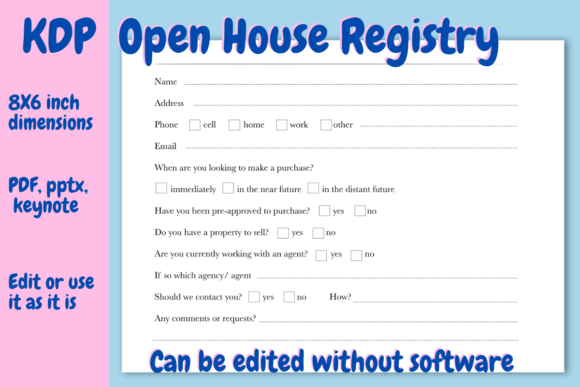
The Open House Registry Book for KDP is structured to meet the practical demands of real estate open houses while adhering to KDP printing standards. The document contains 101 pages in total, formatted in an 8x6 inch landscape orientation. This dimension is significant because landscape formats provide wider writing space, which is often preferred for sign-in sheets where visitors may have limited room to write legibly. The layout includes 98 usable entry pages, allowing for substantial data collection in a single volume.
Each entry page is designed with privacy and usability in mind. Unlike dense sign-in sheets that cram multiple entries onto a single page, this template restricts content to one entry per page. This design choice accommodates large handwriting and ensures that sensitive client information remains private from subsequent visitors. At the top of each page, there is a dedicated line for the agent to record the time and address of the open house, streamlining post-event data organization. The entry fields capture comprehensive lead information, including name, address, phone number, email, purchasing ability, time-frame, and specific housing needs.
Editing Accessibility and File Formats
A primary advantage of this template is its accessibility across different platforms. The package includes PDF, Keynote, and PowerPoint files. Notably, the PowerPoint file was originally formatted in Google Slides. This compatibility means users without Microsoft Office or Apple Keynote can still edit the document using a free Gmail account. Creators can upload the PPTX file directly to Google Drive and modify branding, fonts, or layouts without purchasing additional software.
The editing process is designed to be modular. If a user requires more than 98 entries, they can right-click and duplicate pages within their presentation software. Conversely, extra pages can be deleted to reduce page count and printing costs. The title page and copyright page are included as standard placeholders, with the copyright page intended for users to insert their own brand name. This flexibility allows the Open House Registry for KDP to serve both as a commercial product for sale and as an internal tool for brokerage branding.
Financial Viability and Printing Considerations
For KDP publishers, profit margins are dictated by page count, ink type, and trim size. The Open House Registry for KDP has been tested on the KDP previewer with a calculated printing cost of approximately $2.15 USD. This price point is competitive for an 8x6 landscape book with over 100 pages. When evaluating this template, creators must factor in this fixed cost against their intended retail price or internal distribution budget.
The 8x6 inch landscape trim size is less common than standard portrait journals, which can influence buyer perception. Landscape books are often associated with workbooks, logbooks, and registries rather than traditional notebooks. This alignment with user expectations can improve conversion rates for real estate-specific keywords. However, creators should verify current KDP printing costs before publishing, as rates are subject to change based on paper supply and regional distribution centers. The stated $2.15 cost serves as a baseline for financial modeling but should be validated in the KDP calculator during the upload process.
Situational Fit: When to Use This Template
The Open House Registry for KDP is particularly well-suited for specific user scenarios. Real estate teams looking to standardize their lead capture across multiple agents will benefit from the consistent formatting. By uploading the edited PPTX or Keynote file to KDP, brokerages can order author copies at printing cost, creating professional-branded tools for significantly less than custom commercial printing.
Low-content book creators targeting the real estate niche will also find value in the pre-validated layout. Since the document has already been tested on the KDP preview, it reduces the risk of formatting errors, bleed issues, or margin violations that frequently cause rejection during the publishing review process. The inclusion of qualitative fields like "purchasing ability" and "time-frame" distinguishes this registry from generic guest books, making it a higher-value product for serious real estate professionals.
Additionally, the Google Slides compatibility makes this an ideal starting point for beginners. Users who are intimidated by Adobe InDesign or Affinity Publisher can leverage familiar slide-based interfaces to customize the interior. This lowers the barrier to entry for creating functional, market-ready KDP interiors.
Tradeoffs and Alternative Considerations
While the Open House Registry for KDP offers convenience, potential users must weigh certain tradeoffs. The one-entry-per-page format, while excellent for privacy, results in a thicker book compared to multi-entry layouts. For agents who host high-traffic open houses with dozens of visitors, a 98-entry book may be consumed quickly, necessitating frequent reordering. In such cases, a denser layout with four to six entries per page might offer better longevity, though at the expense of individual privacy and writing space.
The landscape 8x6 dimension, while ergonomic for writing, does not fit standard vertical bookshelves or some clipboard holders designed for portrait documents. Agents who rely on clipboards for mobile sign-ins should verify that this trim size integrates with their existing physical workflows. Furthermore, because the template is slide-based rather than vector-based (like Illustrator or InDesign files), scaling elements up or down may occasionally result in minor alignment shifts. Users should always perform a thorough visual check after resizing or duplicating pages.
For those seeking complete design freedom or unique trim sizes not covered by this template, hiring a freelance designer or learning professional layout software may be a better long-term investment. The Open House Registry for KDP is a templated solution; it provides speed and compliance but limits bespoke typographic or structural innovation. Creators aiming for a highly differentiated aesthetic may find the slide-based constraints restrictive.
Making the Final Decision
Selecting the right KDP template requires balancing ease of use, cost efficiency, and end-user functionality. The Open House Registry for KDP presents a pragmatic solution for creators who prioritize immediate usability and cross-platform editing over granular design control. Its tested compatibility with KDP, accessible file formats, and real estate-specific field structure make it a strong candidate for both commercial publishers and practicing agents.
Before proceeding, evaluate your specific volume needs and physical handling preferences. If privacy, readability, and Google Slides compatibility are top priorities, this template aligns well with those objectives. If maximizing entry density or achieving custom dimensions is more critical, exploring alternative layouts or commissioning custom designs may yield better results. Ultimately, the decision should hinge on whether the 8x6 landscape format and one-entry-per-page structure solve the specific lead capture challenges you face in your real estate practice or publishing portfolio.