Evaluating Reading List KDP Interior for Low-Content Publishing
Selecting the right interior template is a foundational step in creating successful low-content books on Amazon Kindle Direct Publishing (KDP). For publishers focusing on bibliophile niches, book tracking, or literary journals, a specialized Reading List KDP Interior serves as the structural backbone of the product. This resource typically provides pre-formatted pages designed for recording book titles, authors, ratings, and personal reflections. When evaluating these interiors for commercial or personal use, it is necessary to look beyond basic aesthetics and consider technical specifications, market versatility, and production constraints. Understanding the specific attributes of available formats, sizes, and file types allows creators to make informed decisions that align with both reader expectations and platform requirements.
Defining the Reading List KDP Interior Asset
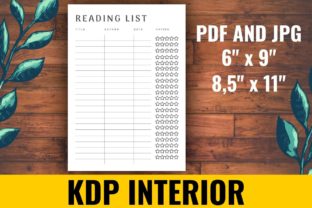
A Reading List KDP Interior is a digital template package specifically engineered for print-on-demand publishing. Unlike a standard lined notebook, this interior includes structured prompts and layouts tailored to cataloging reading habits. Standard packages in this category often contain 100 pages, providing a substantial volume for tracking without resulting in an excessively thick spine that might deter casual users. The core value proposition lies in the balance between structure and freedom; the layout guides the user on what information to record while leaving adequate space for personalized notes.
These interiors are generally distributed in two primary file formats: PDF and JPG. The inclusion of both formats addresses different workflow needs. PDF files are typically preferred for direct upload to KDP because they preserve vector quality, ensuring crisp text and lines at any zoom level. JPG versions serve as a versatile alternative for creators who wish to edit the interior in raster-based software like Photoshop or Canva before compilation, or for those creating digital downloads alongside physical books. Evaluating which format suits your current design ecosystem is the first practical decision point.
Size Considerations: 6x9 vs. 8.5x11 Inches
One of the most critical evaluation criteria is trim size. Availability in both 6x9 inch and 8.5x11 inch versions allows publishers to target distinct user behaviors. There is no universally superior size; rather, each serves a specific functional purpose within the reading community.
The Portability of 6x9 Inch Interiors
The 6x9 inch format is the industry standard for trade paperbacks and is frequently the optimal choice for reading logs intended to be carried alongside physical books. When evaluating this size, consider the end-user's environment. Readers who track books while commuting, traveling, or visiting libraries prefer compact dimensions that fit into tote bags or large pockets. From a publishing perspective, 6x9 interiors often have lower printing costs, which can improve royalty margins or allow for more competitive pricing. However, the tradeoff is limited writing space per entry. If the interior design includes extensive metadata fields (e.g., start date, finish date, genre, rating, quotes), the 6x9 canvas may feel cramped, potentially leading to negative user reviews regarding usability.
The Utility of 8.5x11 Inch Interiors
Conversely, the 8.5x11 inch version caters to home-based tracking and comprehensive journaling. This size offers significantly more horizontal space, making it ideal for complex layouts that include review sections, character maps, or lengthy reflection prompts. Evaluators should select this size if the target audience consists of students, researchers, or avid reviewers who treat their reading log as a reference document rather than a portable accessory. While printing costs are higher and portability is reduced, the perceived value is often greater due to the generous writing area. This size also photographs better for marketing purposes, as the interior details are clearly visible in thumbnail images.
Technical Evaluation of File Formats and Quality
When assessing a Reading List KDP Interior package, technical integrity is as important as visual design. The provision of 100 pages in both PDF and JPG formats suggests a flexible product, but users must verify specific quality metrics before purchase or use.
- Resolution and Bleed: Ensure JPG files are at least 300 DPI at actual print size. Low-resolution interiors result in pixelated text and jagged lines, which are immediate indicators of low quality to buyers. Verify that bleed allowances are correctly applied if the design extends to the page edge.
- Margins and Safe Zones: KDP has strict margin requirements based on page count. A 100-page book requires specific gutter margins to prevent content from being swallowed by the binding. Evaluate whether the template accounts for this, particularly in the 6x9 version where space is already at a premium.
- Editability: Determine if the PDF is flattened or layered. Flattened PDFs are ready for immediate upload but cannot be modified. If you intend to add branding, change fonts, or adjust prompt wording, confirm that editable source files or high-resolution JPGs are included.
Strategic Fit and Market Alignment
Determining whether a pre-made Reading List KDP Interior aligns with your goals requires an honest assessment of your business model and creative capacity. These templates are strongest when speed-to-market and consistency are priorities. For publishers building a series of themed reading journals (e.g., "Mystery Reader Log," "Academic Research Tracker"), having a standardized 100-page base ensures brand coherence across multiple titles. The dual-size availability further enables market testing; a publisher can release both sizes simultaneously to gather data on consumer preference without investing in custom formatting for each variant.
Furthermore, these interiors are well-suited for creators who excel at cover design and keyword research but lack interior layout skills. By outsourcing the pagination and structural design to a professional template, resources can be redirected toward marketing and niche analysis. The 100-page count is also strategically sound; it creates a book thick enough to have a readable spine text (essential for bookstore visibility) while remaining within standard printing tiers.
When to Consider Alternatives
Despite their utility, pre-formatted Reading List KDP Interiors are not the correct solution for every project. There are specific scenarios where alternatives warrant serious consideration.
If your goal is to create a highly differentiated product with unique proprietary tracking systems, generic templates may limit innovation. Standard reading lists often follow conventional layouts that saturate the marketplace. In such cases, hiring a custom designer or learning typesetting software may yield a better return on investment through product uniqueness. Additionally, if you require fewer than 80 or more than 120 pages, a fixed 100-page template introduces inefficiencies. Padding a book with blank pages to reach a minimum threshold degrades user experience, while removing pages from a non-editable PDF is technically prohibitive.
Budget constraints also play a role. While templates are cost-effective compared to custom design, free alternatives exist for hobbyists or those testing concepts with zero financial risk. If the projected sales volume does not justify the upfront cost of a premium template, utilizing free resources or basic word processor formatting may be a more prudent initial step. Finally, consider licensing terms carefully. Some interior packages restrict usage to a single title or prohibit modification. If your strategy involves scaling across dozens of variations, ensure the license supports unlimited commercial use to avoid future legal complications.
Making the Final Decision
Evaluating a Reading List KDP Interior ultimately comes down to matching specifications with intent. The combination of PDF and JPG formats offers necessary flexibility for both direct publishing and creative customization. The availability of 6x9 and 8.5x11 sizes covers the spectrum from portable logging to comprehensive journaling. By systematically reviewing technical quality, margin safety, and alignment with target audience behaviors, publishers can determine if this asset bridges the gap between concept and viable product. Successful selection relies not on finding the perfect template, but on identifying the tool that most efficiently facilitates your specific publishing objectives while meeting the functional standards expected by the reading community.